Affiliate disclosure: This post contains affiliate links. If you buy through them, we may earn a small commission at no extra cost to you.
Most freezers are organized by gravity: whatever went in last sits on top, and whatever went in first is fossilized at the bottom. The result is food you paid for, forgot about, and eventually threw away — plus the daily annoyance of standing in the cold shifting bags around to find one thing. A freezer doesn't need to be beautiful to work. It needs zones, containers that stack, and labels you can read without pulling anything out. Here's how to get there in an afternoon.
Step 1: Empty it and be honest about what's in there
Pull everything out onto the counter. Work fast — frozen food is forgiving for twenty minutes, and a cooler bag buys you longer if you need it. Sort into three piles as you go: keep, toss, and use this week. Toss anything with heavy freezer burn, anything you can't identify, and anything past the point where you'd actually be excited to eat it. Freezing pauses spoilage, but it doesn't pause quality — most cooked leftovers are best within three months, and that bag of shrimp from two winters ago is not going to redeem itself.
Wipe down the shelves and drawers while it's empty. It's the only time you'll want to.
Step 2: Decide your zones before anything goes back
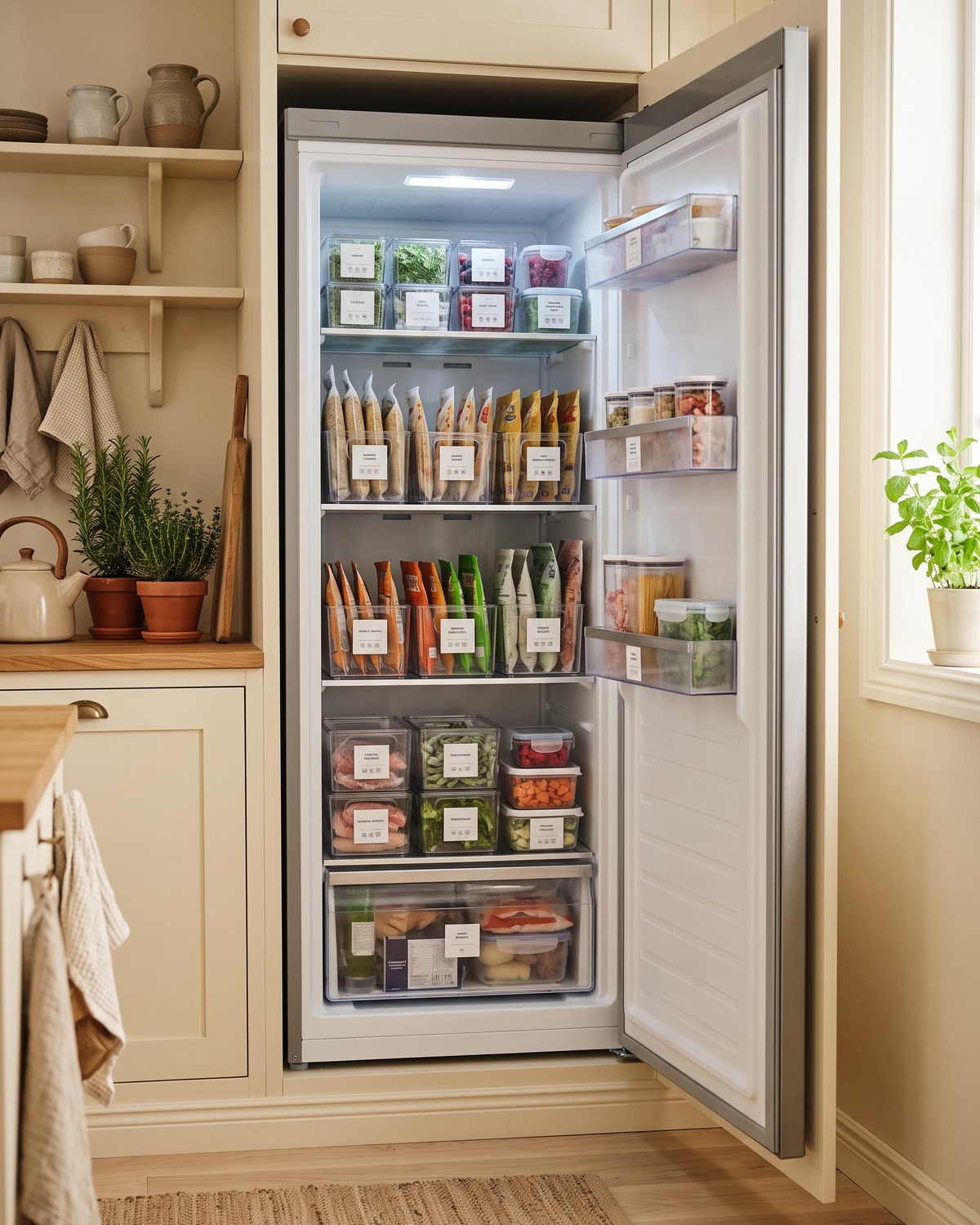
This is the step that makes the difference. Give every category a fixed address so you never have to search: meat and fish in one place, vegetables in another, then bread and baked goods, prepared meals and leftovers, and a small zone for ice cream and treats. Put the things you reach for weekly at eye level or in the front, and the long-term backup items — the stock, the extra butter, the bulk-buy chicken — in the deep back or the bottom drawer.
Write the zone map down on a sticky note the first week if it helps. After that it becomes muscle memory.
Step 3: Use bins so the zones actually hold
Zones drawn in the air collapse in about four days. Zones held by containers survive. A set of clear freezer storage bins turns one deep, chaotic shelf into pull-out drawers you can lift out with one hand and see straight into. Shop on Amazon → For an upright freezer, choose bins tall enough that bags stand up rather than lie in a slippery stack. For a chest freezer, deep bins or hanging wire baskets are what stop the bottom two-thirds from becoming permanently unreachable. Shop on Amazon →
One bin per zone, and the rule follows naturally: if a bin won't close, that category is full.
Step 4: File flat, don't stack
The single biggest space win in any freezer is freezing things flat. Portion soups, stews, sauces, chili and cooked grains into freezer bags, press them thin, and freeze them lying down on a tray. Once solid, stand them upright in a bin like files in a drawer — you'll see every label at a glance and fit three times as much in the same space. Reusable silicone freezer bags do the same job without the waste, and they stand up on their own once frozen. Shop on Amazon →
For anything that would clump — berries, meatballs, dumplings — freeze them spread on a tray first, then bag them. They'll pour instead of arriving as one solid brick.
Step 5: Label everything, including the date
Nothing in a freezer looks like itself. Chicken stock, apple juice and turkey gravy are indistinguishable at month four. Label every single item with what it is and the date it went in — a roll of freezer tape and a marker kept by the freezer takes the decision out of it, or a label maker gives you something that stays legible and doesn't peel off in the cold. Shop on Amazon → Write the date first; it's the piece you'll actually use.
Step 6: Keep a running inventory
Tape a sheet of paper or a small dry-erase board to the freezer door and list what's inside. Shop on Amazon → Cross things off as you use them, add things as you freeze them. It sounds fussy for about a week and then it quietly changes how you cook — you stop buying a fourth bag of frozen corn, and you start planning meals from what you already own. A freezer with a list on the door is a pantry. A freezer without one is a storage unit.
Keep it from refilling
Once a month, before you shop, pick one thing from the freezer to eat that week. Every few months, run a "freezer week" where dinners come mostly from what's already frozen. That single habit keeps the rotation moving, and rotation — not containers — is what actually keeps a freezer organized.
Start today by pulling everything out and throwing away the things you already know you'll never eat. The bins are easy after that.