Affiliate disclosure: This post contains affiliate links. If you buy through them, we may earn a small commission at no extra cost to you.
Everyone has that one cabinet. You open it to grab a container for leftovers, and three lids slide out, none of them matching the base in your hand. The food container cabinet is where organization goes to die, because it's the one category we own too much of and rarely edit. Here's how to fix it in about an hour — and keep it fixed.
Step 1: Pull it all out and match everything
Empty the entire cabinet onto the counter. Every container, every lid. Now play the matching game: pair each base with its lid. Anything that has no partner — a lonely lid, a base with no top — goes in a "maybe" pile. Be honest here. A container without a lid is not storage; it's clutter with potential you'll never use.
Toss anything stained, warped from the dishwasher, cracked, or clouded beyond cleaning. Recycle where you can. Most people finish this step having cut their collection by a third to a half, and they never miss what's gone.
Step 2: Downsize to a system, not a pile
The secret to a calm container cabinet is owning a set, not a random accumulation. Ideally you want containers that nest inside each other and share one or two lid sizes. If you're rebuilding, a matching set of glass food storage containers with uniform lids is worth it — glass doesn't stain or hold odors, goes from fridge to oven, and stacks cleanly. Shop on Amazon → If you're keeping plastic, group it down to one shape family so lids are interchangeable.
Aim for a realistic number: enough for a normal week of leftovers and lunches, plus a few large ones for batch cooking. That's it.
Step 3: Store bases and lids separately
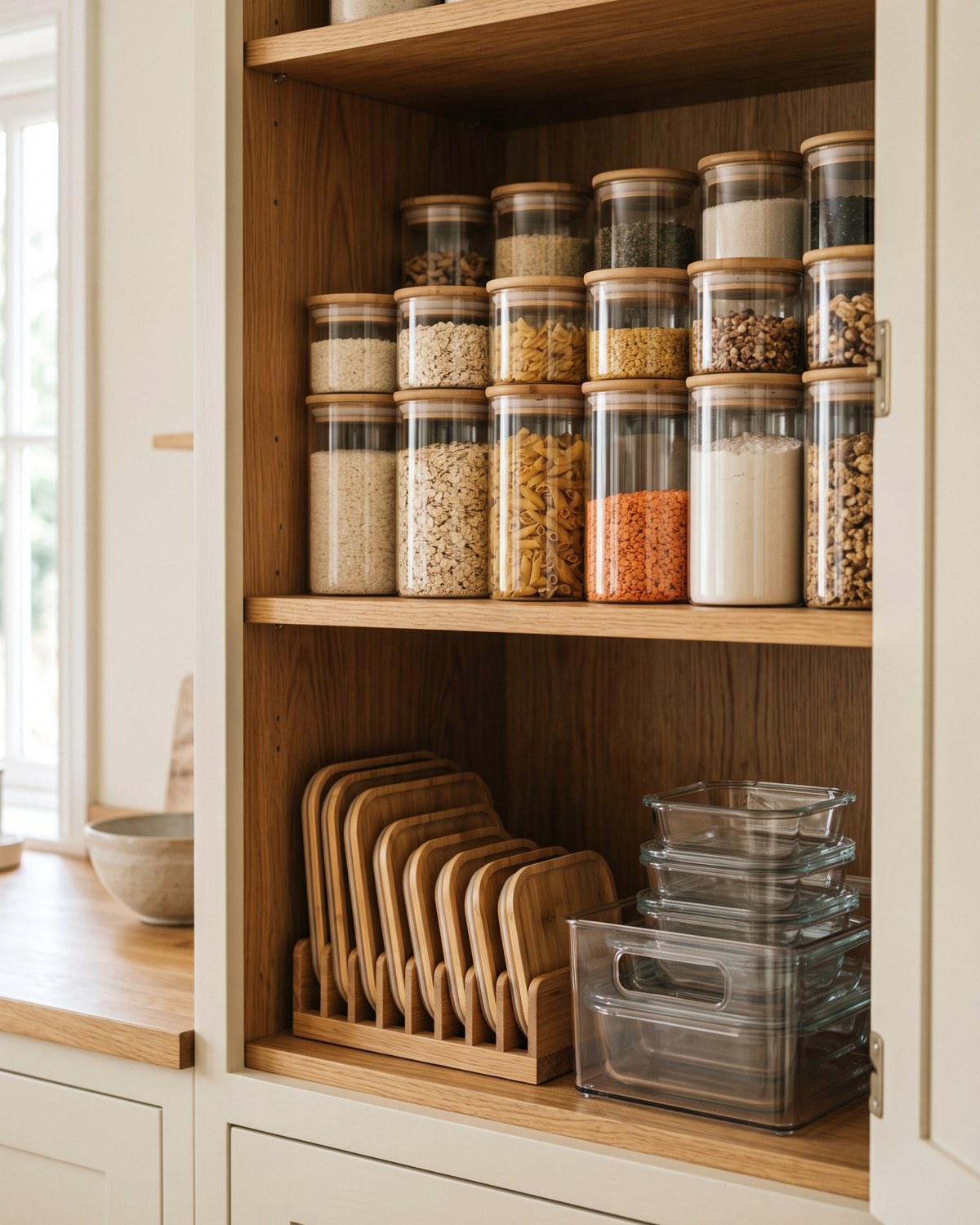
This is the single change that transforms the cabinet. Stop storing lids on their bases — it wastes half your shelf. Instead, nest the bases inside each other in a stack, and stand the lids upright in a dedicated holder. A lid organizer rack with adjustable dividers keeps lids filed like records, so you slide out the one you need instead of excavating. Shop on Amazon → No rack on hand? A small napkin holder or a magazine file turned on its side does the same job.
Step 4: Contain it so it can't sprawl
Even a downsized collection creeps if it has room to. Corral the nested bases in a clear stackable bin so the whole stack pulls out like a drawer and nothing topples to the back. Shop on Amazon → If your cabinet is deep, a bin on a small pull-out tray or a lazy Susan means the back row is finally reachable. For a drawer instead of a cabinet, adjustable drawer dividers create a lane for bases and a lane for upright lids. Shop on Amazon →
Step 5: Give it a home near where you use it
Store containers as close as you can to the fridge or the spot where you pack lunches. The shorter the trip from cabinet to counter to fridge, the more likely the system survives a busy weeknight. Keep the everyday sizes at the front and the big batch-cooking ones up high or in the back.
Keep it from creeping back
The container cabinet is a one-in-one-out zone for life. Every time a takeout tub or a freebie container comes into the house, either it earns a spot by replacing one you toss, or it goes straight to the recycling. And once a season, do a quick match check: any orphaned lids or bases that lost their partner get pulled before they multiply.
The two-minute reset
When you unload the dishwasher, take the extra thirty seconds to nest the bases and file the lids back upright instead of throwing them in. That tiny habit is the difference between a cabinet you dread and one you barely think about.
A tidy container cabinet is a small thing, but you open it several times a day — packing lunch, saving leftovers, reaching for it half-asleep. Start with the great match-up this weekend; the rest falls into place from there.