Affiliate disclosure: This post contains affiliate links. If you buy through them, we may earn a small commission at no extra cost to you.
Board games are stored by optimism: stacked ten high in a closet, boxes slowly crushing under their own weight, lids that no longer close because the box below collapsed. Pull one game from the middle and the whole tower comes down. Add a few puzzles with missing-piece anxiety and a deck of cards held together by a rubber band, and game night starts with ten minutes of excavation. Here's how to store games so the collection survives — and actually gets played.
Step 1: Pull everything out and cut the dead weight
Take every game and puzzle out of the closet and stack them where you can see the whole collection. Now edit ruthlessly: games with missing essential pieces, games your household has outgrown, the duplicate deck of Uno, the puzzle you've done twice and will never do again. Complete games in good shape can be donated or passed to friends; incomplete ones are trash, not donations. What survives should be games you'd happily play this month.
Step 2: Stop stacking — store boxes upright or go vertical
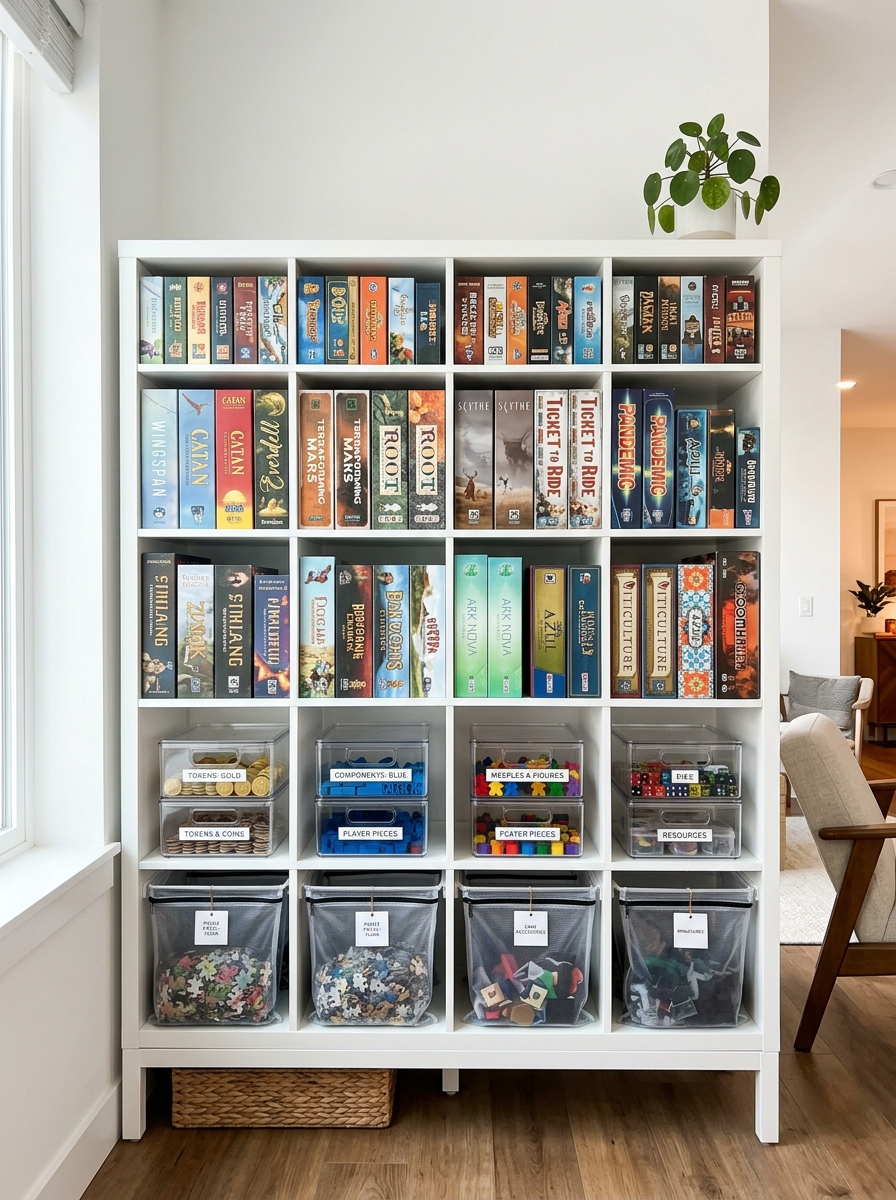
The tower is the enemy. Boxes stored flat in a tall stack crush the ones below and make the middle games unreachable. If your shelf height allows, store big-box games vertically like books, spines out — most modern boxes handle it fine if the components are bagged. For the classic wide, shallow boxes, keep stacks a maximum of four or five high, heaviest on the bottom. A cube storage shelf fits board game boxes almost perfectly, one genre per cube. Shop on Amazon →
Step 3: Bag the bits inside every box
Most game-box chaos is internal: punched-out tokens sliding under the insert, cards loose in a corner. A box of small zip bags fixes an entire collection in one evening — one bag for tokens, one for cards, one per player color. Shop on Amazon → Rubber bands, by contrast, eat card edges and snap with age. For card games whose boxes fell apart long ago, a card storage case holds a dozen decks in labeled rows. Shop on Amazon →
Step 4: Ditch the biggest boxes entirely
Some games are 90 percent air. If shelf space is tight, decant the worst offenders into board game storage bags — flat pouches that hold the board, bagged components, and rulebook in a fraction of the space. Shop on Amazon → The same trick shrinks puzzles: move each puzzle into a mesh puzzle bag with the box art cut out and tucked inside, and twelve puzzle boxes become a single small bin. Shop on Amazon → Keep the collector's editions in their boxes; decant the space-hogs.
Step 5: Zone by audience and label the shelf
Shelve games by who plays them: little-kid games on the lowest shelf where small hands can reach (and small messes are contained), family games at eye level, two-player and adult games higher up. Puzzles get their own zone. A label maker turns the system into a rule the whole house can follow — a labeled slot tells everyone exactly where the game goes back. Shop on Amazon →
Keep game night easy
The system holds if returning a game is as easy as grabbing one. Games go back upright, in their zone, with the bits bagged — a thirty-second job instead of a balancing act. Keep a "current favorites" spot at the front for the three games in heavy rotation, and rotate it monthly.
Start tonight with the edit and a box of zip bags. One evening of bagging tokens, and every future game night starts with playing — not excavating.